Appearance
Configure related business objects
Overview
Service Pass field service centers on accounts, contacts, products, work orders, and equipment. Object relationships, business types, page layouts, and role visibility determine how employees create and process work orders. This guide describes the object fields and equipment work-order settings that administrators configure for each business scenario.
Before you begin
- Use a service pass administrator or an account with object management permissions.
- First maintain the basic data of customers, contacts, products and equipment; the related fields in the work order need to select records from these objects.
- Before using equipment work orders, confirm that the company has enabled equipment management; when using multiple equipment work orders, also confirm that the on-site standard operation plan can handle multiple equipment tasks.
Object relationships and usage scenarios
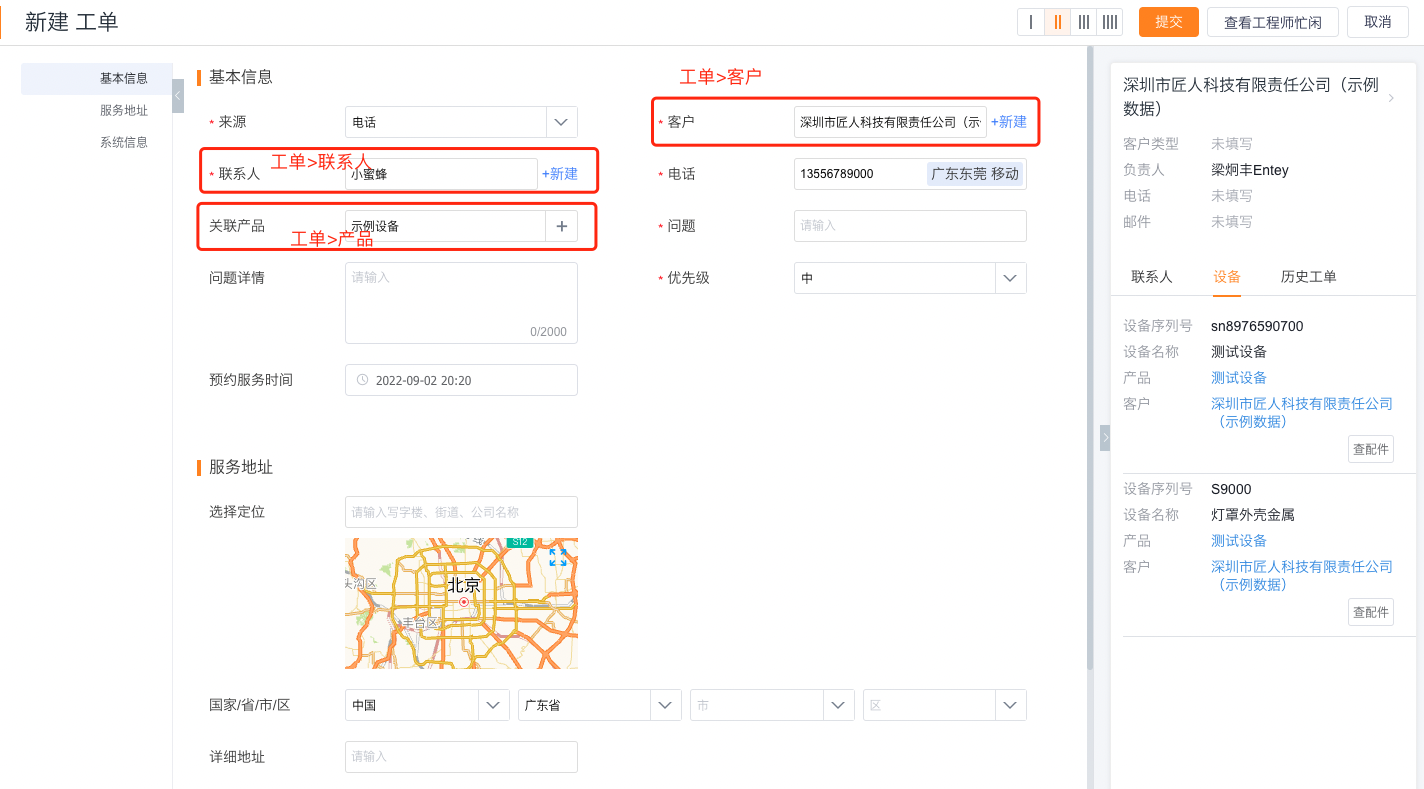
For the relationships among accounts, contacts, and products, see Field work-related objects.
| Object | Role in Service Pass | Configuration or usage points |
|---|---|---|
| Customer | The main body of after-sales service, business records such as work orders, spare parts consumption, expenses and evaluations are usually associated with customers | Continuously maintain customer basic information |
| Contact | The equipment user, request submitter, or evaluation submitter for an account. Individual customers can also have related contacts. | The account is the subject of the work order, but the contact is usually the person contacted for field service. |
| Product | A tangible or intangible product that the company provides to customers. Products also provide a dimension for work-order fault statistics. | Can be used as a maintenance unit for work orders. |
| Work order | Standard object that carries service requests, dispatch orders, on-site execution and result records | API Name is CasesObj; fields, layout and visible roles need to be assigned according to business type |
| Equipment | Record specific equipment and support initiating fault repair reports from device details | A single device can be mapped to a work order through the fault repair button; multiple devices are carried from the object through the work order device |
Configuration steps
1. Configure work order business type
- Enter Work Order > Business Type and switch to card mode.
- When creating a new business type, click New to set the work order type (such as repair, installation, or maintenance), the fields that need to be filled in, and the visible roles of this type.
- Click Save. The system will initialize the new/edit page layout and detail page layout of this business type based on the selected fields.
- If there is an existing business type similar to the new scenario, select Copy and Create of the card, and then set the new type name, visible roles, and the new/edit page layout and detail page layout that need to be copied.
- Create a test work order with the corresponding role, and confirm that the business type, required fields, layout, and role visibility range meet expectations.
2. Configure work order object fields
Adjust field visibility, required settings, and edit permissions for your business needs. The following fields are preset on the work order object. Service Pass maintains fields marked as automatically populated. Do not require employees to enter them manually.
Basic information and service site
| Field name | API Name | Field type | Remarks |
|---|---|---|---|
| Business type | record_type | Business type | |
| Work order number | name | Auto-increment number | |
| Work Order Topic | display_name | Calculated Fields | |
| Question | subject | Single line of text | |
| Problem description | description | Multi-line text | |
| Customer name | account_id | Find association | Associate customer object |
| Contact | contact_id | Find association | Associate contact object |
| Phone | tel | Mobile | |
| Priority | priority | Single choice | |
| Source | resources | Single choice | |
| External source | out_resources | Single choice | The system obtains and backfills by default |
| Category | catalog | Single choice | |
| Related product | field_glcp__c | Lookup relationship | |
| Related equipment | field_glsb__c | Lookup relationship | |
| Appointment service time | booking_time_range__c | Appointment time period | |
| Service positioning | field_serviceAddress__c | Positioning | |
| Condition before service | field_gcjl__c | Multi-line text | |
| Taking photos before service | field_xcpz__c | Pictures | |
| After service photos | field_photos_after_service__c | Pictures | |
| Situation after service | field_situation_after_service__c | Multi-line text |
Process, dispatch and service resources
| Field name | API Name | Field type | Remarks |
|---|---|---|---|
| Work order status | cases_state | Single selection | Can be changed by application node or post-process action |
| Work order status transfer | cases_state_log | Multi-line text | System automatically backfills, development parameters |
| Current node start time | field_currentTaskStartTime__c | Date and time | The system automatically obtains the start time of the current process node. |
| Work order process progress | field_workflowProgressName__c | Single-line text | The system automatically obtains the current process node name. |
| Work order process status | field_workflowStatus__c | Single choice | System automatic changes: in progress, completed, terminated |
| Enterprise external process handler | field_downstreamDealedUser__c | Multi-line text | The system automatically obtains the current process node handler |
| Enterprise external process progress | field_workflowPartnerProgressName__c | Single line text | |
| Enterprise external process status | field_workflowPartnerStatus__c | Single choice | |
| Assignment type | field_assignType__c | Single choice | System automatically backfills |
| Order dispatch method | assign_way__c | Single choice | System automatically backfills |
| Planned service time | plan_time_range__c | Date range | |
| Actual service time | actual_time_range__c | Date range | |
| Order dispatch time | assign_time__c | Date and time | System automatically backfills |
| Assignment status | field_assignStatus__c | Single choice | Automatically populated by the system. |
| Dispatcher | assign_user | Personnel | |
| Service Engineer | field_xcfwry__c | Personnel | |
| Collaborative Engineer | related_service_personnel__c | Personnel | |
| Reason for transfer | reasons_for_transfer__c | Single choice | |
| Reason for order rejection | reasons_for_rejection__c | Single choice | |
| Service Group | field_serviceGroupName__c | Single Choice | System Automatic Backfill |
| Service group ID | field_serviceGroupId__c | Number | System automatically backfills |
| Service team dispatcher | service_group_assign_user | Personnel | System automatically backfills |
| Order dispatch time within the group | service_group_assign_time__c | Date and time | System automatically backfills |
| Order dispatch method within the group | service_group_assign_way__c | Single choice | System automatically backfills |
System status and audit fields
| Field name | API Name | Field type | Remarks |
|---|---|---|---|
| Status | cases_status | Single choice | |
| Locked status | lock_status | Single choice | |
| Life status | life_status | Single choice | |
| Person in charge | owner | Personnel | |
| Belonging to department | data_own_department | Department | |
| Department of the person in charge | owner_department | Single line text | |
| Creation time | create_time | Date time | |
| Created by | created_by | Personnel | |
| External person in charge | out_owner | Personnel | |
| Last modified | last_modified_time | Date and time | |
| Last modified by | last_modified_by | Personnel |
3. Configure equipment work order
Single equipment work order
- Complete the steps in Enable equipment asset management.
- Use the system’s preset Report for Repair button on the device details page. This button comes with preset mapping logic for device information to work orders.
- Adjust the Report a Fault button layout and permissions for your business needs. Verify the equipment fields mapped to the work order.
Applicable scenario: The end user directly initiates a fault repair report after querying the device, and the work order automatically brings in the device-related information.
Multiple equipment work orders
- Enable the multi-device work order capability in the work order object, and add the Work Order Equipment slave object.
- Multiple faulty devices are allowed to be submitted when submitting a work order.
- When different equipment of the same work order needs to perform actions independently, combine the multi-equipment on-site standard operation plan to undertake the equipment tasks respectively; this capability is affected by equipment management and on-site operation configuration.
Applicable scenarios: One repair report includes multiple devices, and each device requires different on-site processing records.
Expected results and verification
- After the new business type is saved, the system generates the corresponding new/edit page and details page layout.
- Employees can only create or process tickets within the business types and fields visible to their role.
- If a single device fails to be reported for repair, the device information can be brought into the work order; for multiple equipment work orders, the devices can be recorded separately in the work order device object.
- The work order status, dispatch status and process progress fields are automatically updated according to the process or dispatch action.
Notes
- When the basic data of customers, contacts, products and equipment is incomplete, the work order related search may not be able to select the target record.
- The visible roles, field permissions and workbench menu of the business type need to be configured at the same time; configuring only one of them will not automatically open the complete entrance.
- The system automatically backfills fields for process tracking and auditing. Do not set them as required fields for employees to manually enter.
- Multi-equipment scenarios require additional configuration of work order equipment and on-site operation plans, which is not equivalent to simple copying of a single equipment work order.